En Passant
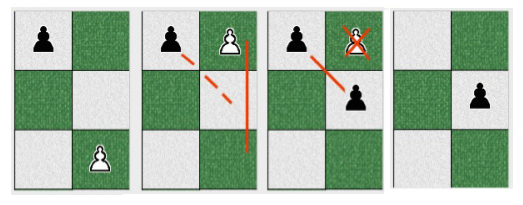
En passant is a special pawn capture move that can only occur immediately after a pawn moves two ranks forward from its starting position, and an enemy pawn could have captured it had the pawn moved only one square forward. The opponent captures the just-moved pawn “as it passes” through the first square. The resulting position is the same as if the pawn had moved only one square forward and the enemy pawn had captured it normally. The en passant capture must be made at the very next turn, or the right to do so is lost. It is the only occasion in chess in which a piece is captured but is not replaced on its square by the capturing piece.
The en passant capture rule was added in the 15th century when the rule that gave pawns an initial double-step move was introduced. It prevents a pawn from using the two-square advance to pass an adjacent enemy pawn without the risk of being captured. Allowing the en passant capture, together with the introduction of the two-square first move for pawns, was one of the last major rule changes in European chess, and occurred between 1200 and 1600.
In today’s chess club meeting, we showed a Chesskid.com video that explains the en passant rule. You can view that video here:
Knight Shadow
At Friday’s club meeting, we showed a video on achieving checkmate with only a King and Queen. The Queen is used to drive the opponent’s King into a corner by using the Knight’s shadow technique. Care must be taken to leave some room for the opponent’s King to move, to avoid a stalemate position. The King then drives up the board to support the queen in the final checkmate move.
There is also a good article on Wikipedia that describes checkmate with only a King and Queen.
Giant Chess at Wooldridge Park
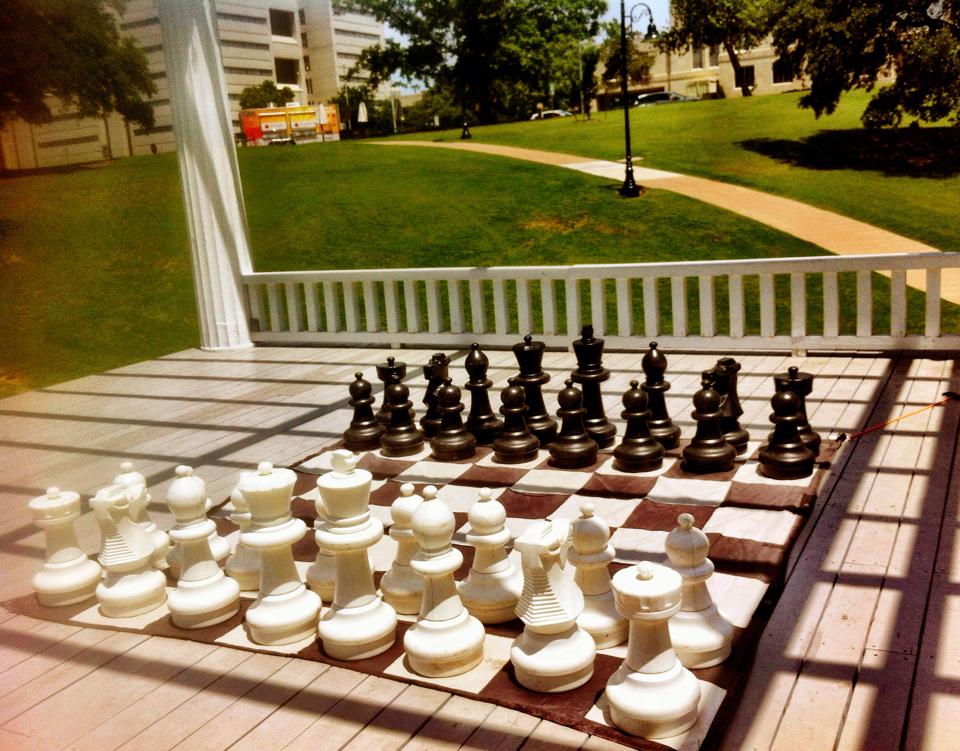
Every Saturday afternoon from 12:30 to 3:30, when the weather permits, the Austin Parks Foundation sets up a giant chess set in the white gazebo at Wooldridge Park in downtown Austin. You can see posts and photos on their Facebook page.
Fried Liver Attack
At this morning’s chess club meeting, we showed a Chesskid.com video on the Fried Liver Attack opening.
The Fried Liver Attack, also called the Fegatello Attack (named after an Italian idiom meaning “dead as a piece of liver”), is a chess opening. This colorfully named opening is a variation of the Two Knights Defense in which White sacrifices a knight for an attack on Black’s king.
The Fried Liver has been known for many centuries, the earliest known example being a game played by Giulio Cesare Polerio in about 1610.
Mountain Laurel Tournament Results
Spicewood Elementary students participated in the Mountain Laurel Elementary Chess Tournament on Saturday, April 11th, 2015. Congratulations to all of our students who participated in this tournament.
We never lose
Laurel Mountain Tournament This Weekend
The last scholastic tournament of the school year is this Saturday, April 11th at Laurel Mountain Elementary. There will be NO onsite registration, and your last chance to register online is this Wednesday, April 8th by midnight. This tournament has a 400 player cap and they are already at 390, so if you are planning to attend, you should click the registration link below.
Laurel Mountain Elementary chess tournament website
Tournament registration website
Good luck to all of our students this weekend!
[google-map-v3 shortcodeid=”cb42dbb302″ width=”900″ height=”600″ zoom=”17″ maptype=”hybrid” mapalign=”center” directionhint=”true” language=”default” poweredby=”false” maptypecontrol=”true” pancontrol=”true” zoomcontrol=”true” scalecontrol=”true” streetviewcontrol=”true” scrollwheelcontrol=”false” draggable=”true” tiltfourtyfive=”false” enablegeolocationmarker=”true” enablemarkerclustering=”false” addmarkermashup=”false” addmarkermashupbubble=”false” addmarkerlist=”10111 D-K Ranch Road, Austin, TX 78759{}1-default.png{}Laurel Mountain Elementary School” bubbleautopan=”true” distanceunits=”miles” showbike=”false” showtraffic=”false” showpanoramio=”false”]
Scholar’s Mate
At today’s Chess Club meeting, we showed a video on how to anticipate and defend against the Scholar’s Mate. The Scholar’s Mate is sometimes referred to as the “Four-Move Checkmate”, although there are other ways to checkmate in four moves. We also introduced the students to the “Squares of Doom”, which are the weakest squares on the chess board, F2 and F7, because they are only defended by the King. The Scholar’s Mate uses this weakness of the square of doom to checkmate the King.
The Scholar’s Mate is known by different names in other countries:
- In some languages, including French, Turkish, German, Dutch, Spanish and Portuguese: Shepherd’s Mate
- In Italian: Barber’s Mate
- In Persian, Greek and Arabic: Napoleon’s Plan
- In Russian: Children’s Mate
- In Polish, Danish, German, Croatian, Hungarian, Slovenian, Slovakian and Hebrew: Shoemaker’s Mate
- In Finnish, Swedish, Norwegian and Danish: School Mate
- In Esperanto: Stultula Mato
Chesskid.com Opening Traps: Scholar’s Mate Video Link that shows examples on how to defend if your opponent bring out their Bishop first.
A followup video is also recommended to watch where they show how to defend if your opponent bring out their Queen first.
The Noble Game – A Short Film
This is a ~30 minute short film that documents scholastic chess in France. It follows kids and parents as they compete in a tournament to earn a spot in the French championship tournament. While it is in French, it has subtitles and worth watching to get a better understanding of the tournament experience.


You must be logged in to post a comment.